Tuesday, July 19, 2011

Alder Flycatchers of the Vermilon River. A Post to WBW

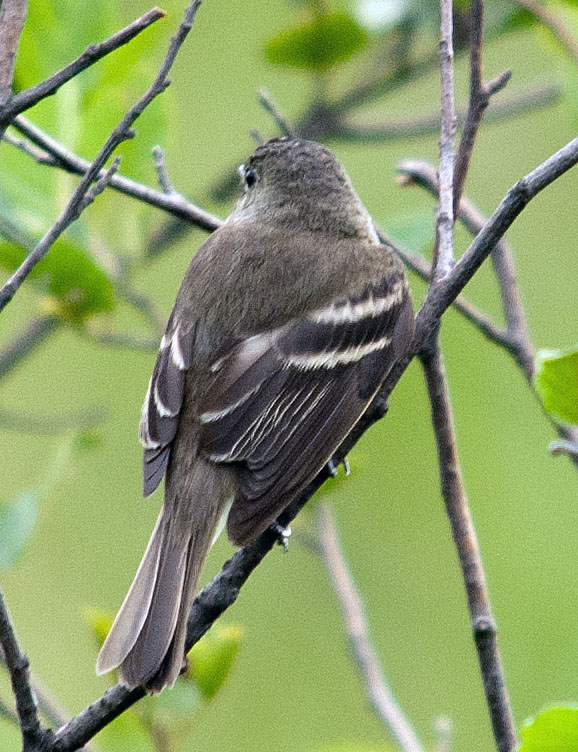
Alder Flycatcher
I had posted these two photos as unknowns in my Warbler post of last week, and requested some ID help. Hilke came up with the ID suggesting they were Alder Flycatchers from their eye ring and prominent carriage, and I expect the wash on their lower chests. Well lo and behold, when I was hiking this week who came to pose for me almost perfectly, I might add, but another of these guys!!
Alder Flycatcher.

Alder Flycatcher.

Alder Flycatcher.

100% blow up.

These photos confirm Hilke's ID. So way to go, Hilke. These birds are illusive and I can attest to that. The common ID is the white eye ring, the triangular head, and the orange lower mandible, as well as the wing bars, although all the websites pointed out the difficulty with identification, and the fact that little is known about the flycatcher group. These guys get their name from from their preference to live in alder groves, where they feed on insects and berries. In this case they're living in the dogwood and pin cherry brush that borders the feeder creek that joins the the Long Lake wetland to the east track wetland. 

By the way the 100% blow up shows the quality of the Sigma 150-500mm. lens. You won't do much better than that.

Sunday, July 17, 2011

Hiking the Long Lake Wetlands. A Post to My World Tuesday.

Looking North
 With the uneven weather I'm a bit out of shape, so I took a concerted effort to hike twice in a row. Remember I'm lame so I have to work at this a lot harder than you. I suppose the heat and humidity isn't helping either. Anyway this brought me to the wetlands twice in a row, no real chore of course. These are two views of the wetland itself.


I had said in a previous post that I would add some further fireweed shots to show you its vivid colour. It gets its name from the fact that it is the first plant to begin the regeneration cycle after a forest fire. Nature is pretty smart. This weed is growing in an area of pin cherries, and dogwood on the borders of a small creek that feed the lower wetlands. The larger shots are not as advanced as the field shot, as the blooms start at the bottom and move upwards. You can see the pink tips on the plant in the field shot.
From The Southern End.

Field of Fireweed

Fireweed

Close Up.

Goat's Beard.

Spreading Dog bane.

Common Milkweed.

Bladder Campion.

Common Yarrow.

Common Mullein

Ripe Blueberries.

 All of the wildflowers are growing like crazy. The milkweed is covered in insects as you can see.The biggest problem was avoiding the stinging insects. Goat's Beard and Campion are favourites of mine so I include them wherever I can. Yarrow is distinguished from Queen Anne's lace by the fern like leaves. The blueberries no longer exist; I ate them all. The flowers of the Common Mullein grow on the stalk, and only a few seem to bloom at a time.


Dragonfly
 I included the dragonflies for Bob and Birgitta who were so intrigued by my previous post. This is a white Dragonfly in the top photo, and if you look closely at the wings in the second photo, they're two tone, clear and brown. He's also a white dragonfly. The moth is a close up of the one in the milkweed photo. I think Blogger is telling me that I'm out of copy space. But no post would be complete without a few birds.

So I included the Waxwings, the Song Sparrows, the Goldfinch, and the Robin to finish off. I'm not certain if the in flight pictures are of a Raven or a crow. It's too hard to tell.
Moth.

Cedar Waxwing.

Cedar Waxwing.

Song Sparrow

Song Sparrow


Raven or Crow.

Robin

Male Goldfinch.

Thursday, July 14, 2011

Sunny days at the Vermilon River. A Post to SWF

Fair Skies


Much like everyone else we've had on again and off again weather. It's inhibited my hiking, but the forest is still healthy with the rainfall, and full of life.
Stormy Skies

Still Looking for a Sun dog.

Red Squirrel

Red Squirrel

Wild Chicory.
The Red Squirrel was pretty active which as I said  earlier is a surprise since he is on every one's lunch menu. We don't have grays or blacks here. It was great finding the Chicory, as I don't remember it from last year.


Common Milkweed.


 And I'll bet you didn't think common milkweed was so attractive when it flowers. I read on another web site that it has many medicinal properties.


It's that time of year for the goldenrod's to flower. Fortunately Boom and I are not allergic to them.
One of the Goldenrod's.

Ripening Blueberries.


We saw lots of human berry pickers out,but no bears. The berries are sold through co-ops and sold at a premium in grocery stores as wild berries although smaller are much sweeter than farm grown ones.


Vipers Bugloss.

Dragonfly
No post would be complete without some insects or birds. So here they are. I included some current shots of Huegy, our pet crow, and much to Boomer's chagrin a picture of his mate. Huegy, if you look closely has a gray feather on one wing. A scar from all the fights with the blackbirds. That's how I recognize him. He also calls out to us on our morning walks looking for peanuts probably.


I'll post this to Sky Watch Friday. And maybe to camera Critters and scenic Sunday. I'm putting this information here as the great Blogger/ Google is telling me there is no java script at the bottom of the page.

 Just a quick note: The new lens I referred to in my last post was new last year, not this year. I just think you sort of grow into technical things. It's a Sigma 150-500mm lens and I'm really pleased with it.
Female Goldfinch.

Mourning Dove.

Northern Flicker.

Huegy

Huegy's Mate

Tuesday, July 12, 2011

New And Old Friends of the Vermilon River. A Post to WBW

Yellow Warbler
This post started off as a new friends post, but I ran into instant problems. Should that include winter birds, the new black birds, woodpeckers,swallows etc.; and I'm in a negative mood with Blogger and its dictatorial, and its incompetent ways. So the post became a sort of new warbler post with some other friends included. I'll just explain why I put them in. I think seeing all these new birds is the result of having the new lens, the healthy state of the forest, and global warming which is bringing new wildlife this way. The yellow Warbler is new for me and our ten mile stretch that we travel in.( For new readers the forest runs for hundreds of miles as I explained in another post, but we limit ourselves to a ten mile stretch.)


Yellow Warbler


American Redstart.


American Redstarts are not new to me or the area, but this is the first time I have been able to capture them so well.

American Redstart.


I think the lens makes quite a difference, because all these birds are small and the forest canopy is thick. It's one thing to see them, but it's a double thrill to have good photos of them. Redstarts are warblers by the way.

Common Yellowthroat.


This was a real thrill as the Common Yellowthroats are new to me. And the colours are so vivid.

Common Yellowthroat.


Yellow-rumped Warbler.


I both saw and photographed these guys last year. But I have the impression that there are more around this year, and I got some good photos of an especially handsome bird with a dumb name.

Chestnut-sided Warbler.
The chestnut-sided Warblers seemed to be more abundant, in more areas, and easier to photograph, except my guys are always in a windstorm.

Chestnut sided Warbler.


Chestnut-sided Warbler.


Nashville Warbler?


Nashville Warbler?


I have this guy pegged as a Nashville or Connecticut immature, but I'm not certain got any idea?

Female Pine Sisken


Female Pine Sisken.


If anyone remembers an earlier post, I featured a little female pine sisken on my picnic table who in the midst of food was napping. I'm sure this is her again, and she's all grown up.

American Woodcock.


American Woodcock.


Definitely not Warblers! These photos of an American Woodcock were a first for me. I'm amazed that the bird was on this trail as the fox hunts here regularly.


A Post to WBW@http://pinerivereview.blogspot.com/