|
| Male Hairy |
The first series are Hairy Woodpeckers with the red patch distinguishing the male. They are larger than the Downy ( see below ) over all, although they look alike. The beak is the give away as it is approximately the same size as the head. Another difference is the Downy has black markings on its tail feathers. But the colourings are basically the same and they co-exist, but do not interbreed.
 |
| Male Hairy Showing Red Patch. |
 |
| Male Hairy Showing Red Patch. |
 |
| Female Hairy No Red Patch and no black markings on her tail. |
 |
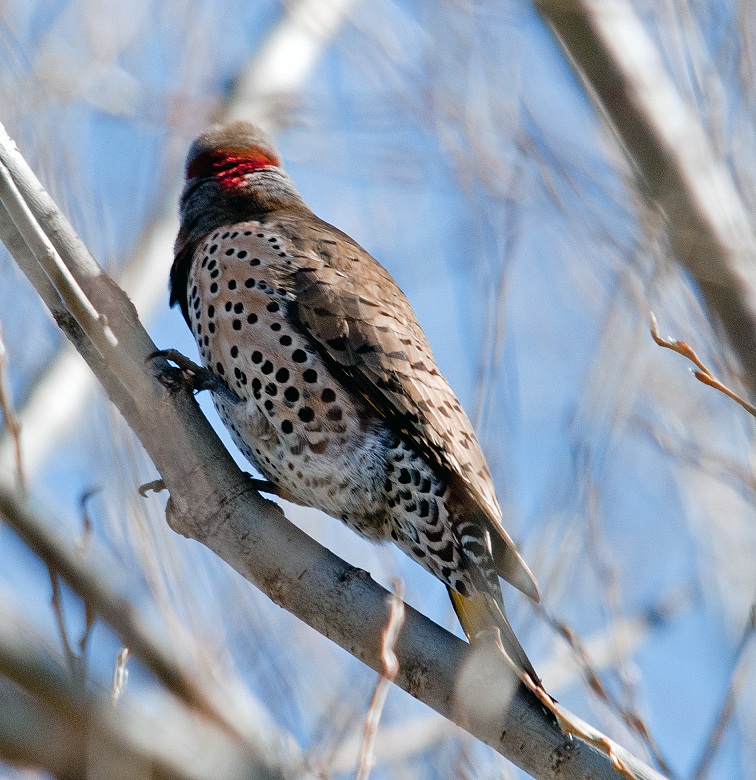
| Male Northern Flicker with black mustache off beak. |
 |
| Both Male & Female Have Red Patch. |
Both the male and female Northern Flicker are identical, except the male has a black mustache running off the beak. So both have the red V.
They are ground woodpeckers feeding primarily on ants as well as using the formic acid in ants to clean their feathers. On the ground their plumage acts as a camouflage, so they're hard to photograph because you're on them, and they're away. Some people call them yellow shaft flickers, because the edge of their wing is a gold/yellow, and readily seen in flight. The Hairy and the Northern Flicker are large birds.
 |
| Female no black mustache off beak. |
 |
| Male black mustache off beak. |
 |
| Female no mustache. |
 |
| Male Downy |
 |
| Female Downy. |
The Downy is smaller, but the beak is the quick id point. See how small it is in the above photo. In the photo opposite you can see the black markings on her her tail feathers. The Hairy does not have these markings. Sorry the Downy photos are not better. Although they co-exist, I generally see the Hairy's, so I was quite excited even to get these shots.
 |
| Male Downy in flight. |
 |
| Pileated Male with red mustache off beak. |
Of course this is the largest woodpecker of all, the Pileated. He's about the size of a crow, and his tapping is aptly called drumming. His call sounds quite wild and I think he is the roll model for the cartoon character Woody Woodpecker.
He's a male because he has a red mustache running off his beak.
A Post to WBW @
http://pineriverreview.blogspot.com/
Just a quick note: I was finding hiking and carrying all the camera equipment a bit of a chore with my old pack sack, so I purchased a proper camera backpack. The thinktank model called a pro streewalker, somewhat misnamed for the forest where there are no streets and few walkers, allows me to carry the camera assembled with the 150-500mm lens, plus tote my tripod and other lens. So far it's working out well; of course, losing 20 years would have done well also.